Figure 1: HMS Challenger in the Southern Ocean,
(Public domain, Herbert Swire)
The Challenger expedition was a global oceanic research expedition conducted between 1872 and 1876. It was the first of its kind, spanning the Pacific, Atlantic and Southern Oceans for the “collection of the objects of research, for the prosecution of the physical and chemical investigations, and for the study and preservation of the specimens of organic life…”(Thomson, 1878:76).
The expedition covered 68,890 nautical miles (127,580 km) of the Pacific, Atlantic and Southern Oceans, involved 719 days at sea, 504 experimental stations, 374 depth soundings, 111 dredge stations, and 129 trawls. It is estimated that the researchers filled nearly 50,000 bottles and jars, using ~25,000 gallons of alcohol to preserve specimens. The expedition was estimated to have yielded over 600 wooden cases containing over 100,000 specimens from the ocean's depths, surface and its shores.
And on May 9, 1873, the HMS Challenger made a stop in Halifax, during which they donated specimens now held in the collection of the Nova Scotia Museum.
In the early 19th century, there was great uncertainty as to what existed on the ocean floor at the greatest depths. The depths of the ocean remained largely unexplored, and the azoic theory, the idea that the depths of the sea were lifeless, was accepted by many. It was thought that the deepest reaches of the ocean were too cold, too dark and under too much pressure to sustain life. However, by the mid to late 1800s, this understanding was shifting.
During the early to mid-1800s, knowledge was spreading faster than ever around the globe – the steam printing press enabled the mass production of publications, photography allowed for the capture of moments in place and time, and steam power permitted faster movement of ships over the sea. Transatlantic communication was underway via undersea transoceanic cables and during the repair of these cables, to the surprise of many, assorted forms of life were being brought up from great depths of the sea.
The timing of the HMS Challenger expedition (1872 – 1876), during the Victoria era, a time of great curiosity in the natural world, was just right for an expedition of its scope and capacity. Photography had been recently adapted for outdoor use and there were several new and promising technologies for studying oceanic characteristics and for collecting samples of ocean life. Shorter expeditions of a narrower geographic scope, such as that of the HMS Lightning (1868) and the HMS Porcupine (1869/1870), which sought to examine characteristics of oceanic waters and the ocean floor, were revealing some surprising results.
The Ship
The HMS Challenger was a 226 foot three-masted wooden Pearl-class corvette. Designed for both steam and sail power, it was initially used as a warship then later retrofitted for the expedition. The task of adapting the ship for a research expedition was extensive, requiring the removal of the tools of war and the addition of equipment for research. Dredging platforms were built on the decks to accommodate the examination of large quantities of mud brought from the deep and disposal shafts were installed for the return of mud to the sea. Laboratories, storage areas, photography rooms, and a large cabin for the lead scientist replaced the battery of guns. The research required carrying incredible quantities of hemp rope and alcohol for the preservation of specimens.
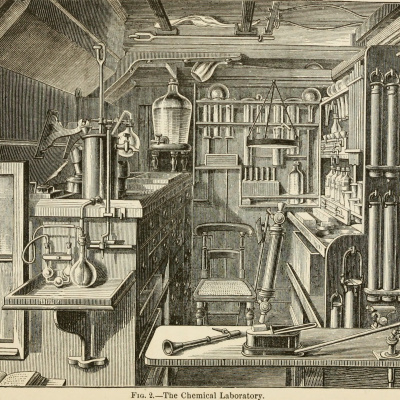

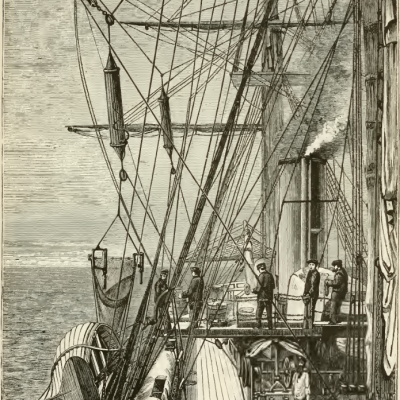


Departure, and a visit to Halifax (May 9 -19th, 1873)
In December 1872, the HMS Challenger departed England. The crew aboard was large, comprised of some 234 people, including sailors, engineers, carpenters, marines, and a scientific team led by the ships Scientific Director, Charles Wyville Thomson, a Scottish naturalist. Included in this crew were three naturalists (John Murray, Henry Nottidge Moseley, and Rudolph von Willemoes-Suhm), a chemist (John Young Buchanan), and an artist (John James Wild). The Challenger was the first expedition to embrace photography to such a degree that they had a photographer for the duration of the trip.

Photo Caption
Figure 4: Charles Wyville Thomson, Scientific Director for the HMS Challenger. NSM P155.3. This cart-de-visite was given during the visit to Halifax, in May 1873.
““It has often been said that studying the depths of the sea is like hovering a balloon high above an unknown land which is hidden by clouds, for it is a peculiarity of oceanic research that direct observations of the abyss are impracticable. Instead of the complete picture which vision gives, we have to rely upon a patiently put together mosaic representation of the discoveries made from time to time by sinking instruments and appliances into the deep, and bringing to the surface material for examination and study.”
”
After departing Sheerness, England Dec 7, 1872, the ship made several stops, including Portsmouth, Lisbon, Gibraltar, Madeira, Tenerife, St. Thomas (British Virgin Islands), and Bermuda. During these early days they had rough weather, and a lot of initial challenges – such as the loss of equipment and equipment failure. By May 8th 1873, the ship was 90 miles south of Halifax on the La Have Bank with crew catching large cod with hand lines.
““lines were out all round the ship, and upward of a hundred cod were taken, the largest about thirty pounds weight. The stomachs of all of them were full of the Ophiopholis.” [referring to Ophiopholis aculeata, the brittle star]
”

Photo Caption
Figure 5: A graph of the depth and temperature distribution between Halifax (far left) Bermuda (middle) and St. Thomas (right). Thomson (1878).
On the morning of May 9th, the ship arrived in Halifax Harbour. Thomson (1878:356) reports on a remarkable mirage that appeared as the ship approached Halifax:
““The weather was very fine and perfectly still, with a light mist, and as we steamed up the bay there was a most extraordinary and bewildering display of mirage. The sea and the land and the sky were hopelessly confused; all the objects along the shore drawn up out of all proportion, the white cottages standing out like pillars and light-houses, and all the low rocky islands looking as if they were crowned with battlements and towers. Low, hazy islands which had no place on the chart bounded the horizon, and faded away while one was looking at them. The little coasting vessels with their hulls drawn up looked as if they were standing on pedestals, while, above them, their inverted images on the soft gray mist were more real and definite than they were themselves. None of us had ever seen such an extreme effect before, nor have we seen any thing like it since.”
”
At the time of the visit, the Nova Scotia Museum was housed in a room of the Post Office, a building now a part of the Art Gallery of Nova Scotia on Hollis Street. Thomson (1878:357) commented on his arrival:
““Halifax is not a pretty town. It reminds one greatly of Greenock or a second-rate English sea-port, with its dull streets of square houses blackened with coal-smoke.”
”
But he was certainly more enamoured by Nova Scotia’s spring flora:
““But by far the most charming of the Nova Scotia spring flowers was the May-flower (Epigaea repens), which a week or two before had been struggling to form its buds beneath the snow, and was now stretching out its long, trailing sprays, covered with trusses of pale flowers, among the grass and moss. Day after day we filled our cabins with wreaths of it, and enjoyed its delicate perfume…”
”

Figure 6: Trailing arbutus, or mayflower (Epigaea repens), a low trailing heath that blooms in the spring. Twenty-eight years after the arrival of the HMS Challenger to Halifax, this species would be designated as the Provincial flower of Nova Scotia.
Maria Frances Ann Morris Miller (1866), public domain.
During their ten-day visit to Halifax, members of the ship came to shore, and some took short trips as far as New York City and Boston. Although the weather was sometimes challenging, offering rain and snow during their visit, short trips were taken to Point Pleasant “The Point”, to visit Mi’kmaq communities and to a local gold mine. At Point Pleasant, near the Prince of Wales Tower, Reverend Dr. David Honeyman, museum curator and Provincial Geologist showed crew members an area of exposed Silurian schist bearing an array of parallel grooves - evidence of glacial movement over the land during the last Glacial Maximum. Visitors to the tower can still observe these striations in the rock.
Members of the community were also invited to visit the ship, such as a group from the “Halifax Institute of Natural Science”– led by Dr. Honeyman and Alexander Agassiz, a naturalist with the Museum of Comparative Zoology at Harvard, in Cambridge, Massachusetts. Agassiz, who had previously examined specimens collected on the HMS Porcupine and HMS Lightning cruises would later play a critical role in the examination of marine invertebrates collected during the Challenger expedition such as sea urchins and sand dollars (Echinoidea) and brittle stars (Ophiuroidea).
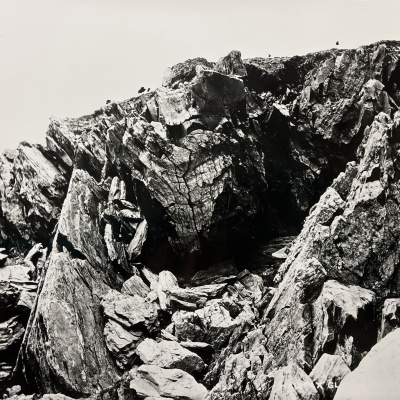
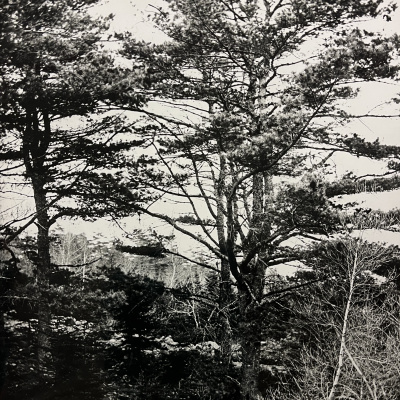

-
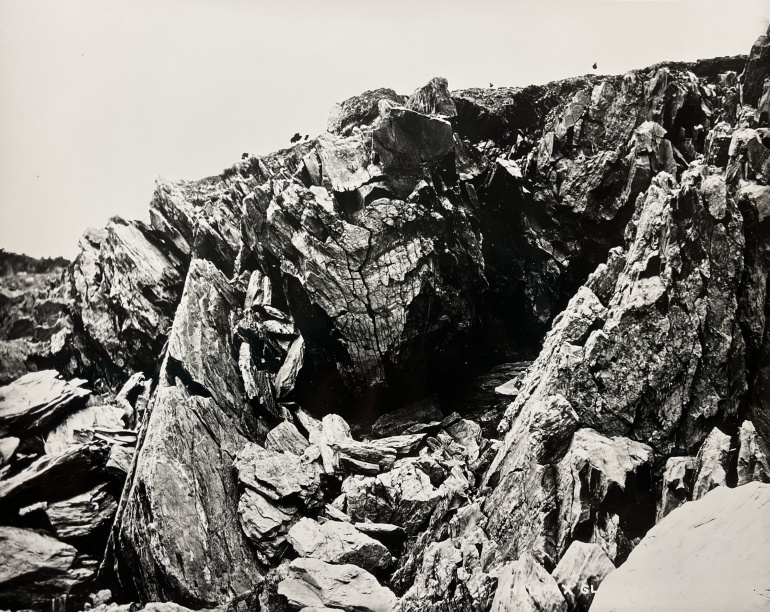
Images among several that were taken when the HMS Challenger visited Halifax, Nova Scotia. One (left) showing a syncline, or fold, in rock along the shore near Point Pleasant Park. -
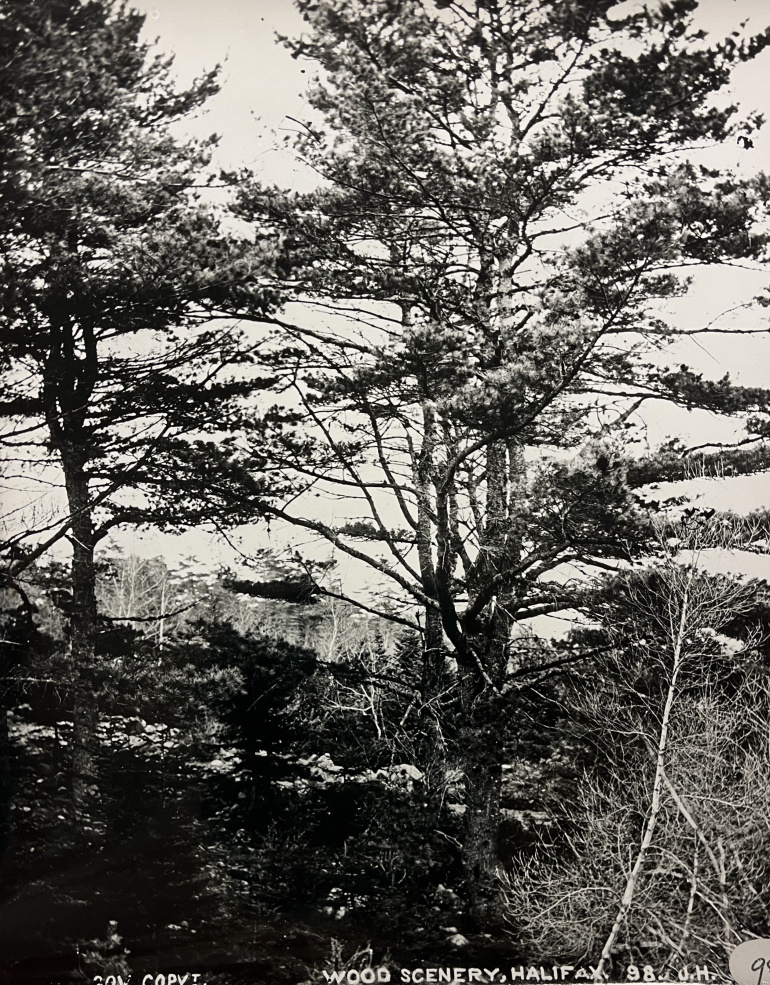
Images among several that were taken when the HMS Challenger visited Halifax, Nova Scotia, near Point Pleasant Park; and a woodland scene. -
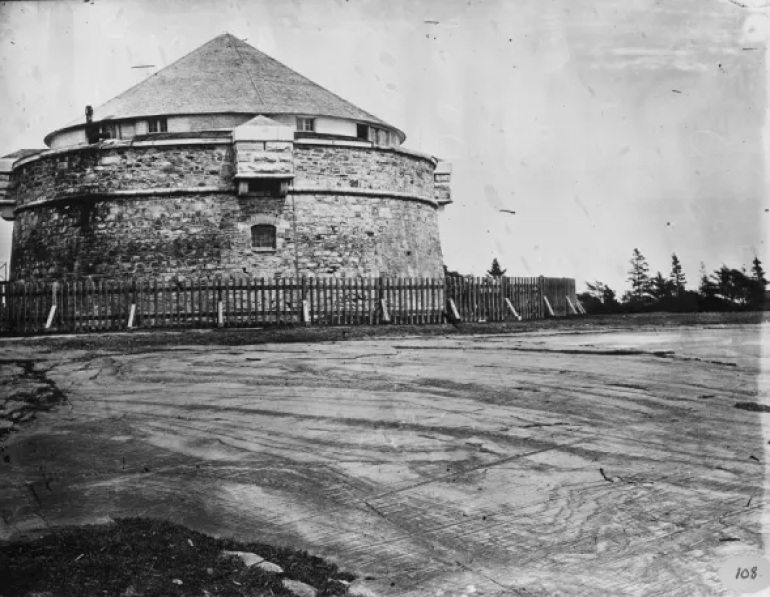
Image taken during a visit to "The Point" (Point Pleasant Park). Here, Dr. Honeyman showed crew members glacial striations in the rock - these are still visible if you visit the site today.


During the visit, Thomson gave Dr. Honeyman a small subset of specimens, including small shells, bryozoans, foraminifera, sponge spicules and crinoids. Most of these specimens are incredibly small – organisms found as a result from fine sifting of deep oceanic muds. These specimens were provided, along with their collection information (locations of origin, collection depths, and the type of mud they were collected from). Here you can find this collection of specimens available online. And, in 1973 NSM Curator, Derek S. Davis, prepared a curatorial report on these specimens.
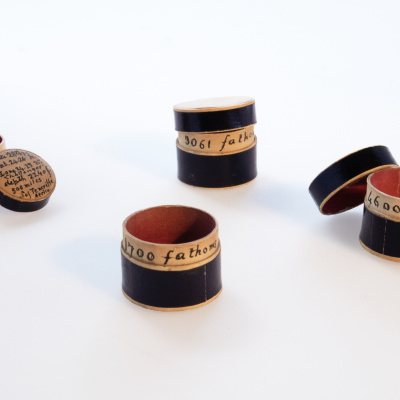
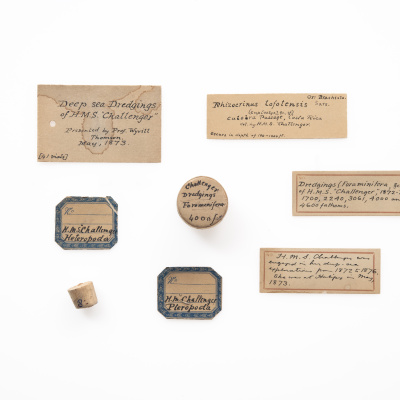
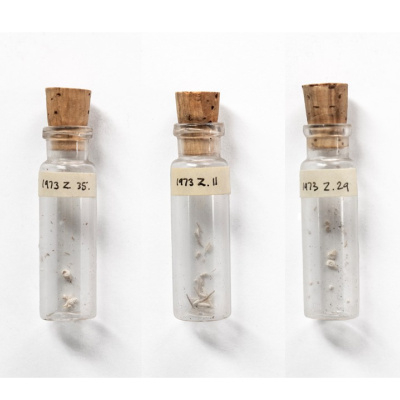


Photo Caption
Figure 9: NSM 973.056.000.002: A specimen of Heliometra glacialis, a crinoid or sea lily.
A global venture with significant findings
The Challenger Expedition continued until 1876, covering 68,890 nautical miles (127,580km) of the Pacific, Atlantic and Southern Oceans. Stops included but were not limited to Kerguelen Island, New Zealand, the China Sea, Honolulu, Valparaiso, the Straits of Magellan, and the Azores. Along the way they collected over 100,000 marine animals, plants, sea floor deposits and rocks as well as oceanographic data, such as temperature, salinity, and depth.
The research findings of the expedition were significant, yielding information on the biodiversity of the world’s oceans, oceanographic characteristics, and nature of the sea floor. The examination of ocean temperatures and salinity revealed that the ocean was comprised of waters of different densities - a result of differences in salinity and temperature. The examination of areas with warm and cool areas of water helped in understanding the oceans currents and the distribution of life.
In the Pacific Ocean, on the 23 of March, 1875, an incredible ocean depth of 4475 fathoms (8183m) was marked off the coast of Japan. They had found what came to be known as “the Challenger Deep”, a flank of the world’s deepest ocean trench, the Mariana Trench. The expedition also discovered large areas of the ocean floor covered in small manganese nodules. These were small rocks formed of concentric rings of iron, manganese and other minerals that turned out to contain a core of ‘cosmic dust’ - micrometeorites!
In a truly collaborative effort, upon the completion of the voyage, specimens were repackaged and shipped for examination by specialists around the world, including individuals such as Georg Ossian Sars, Ernst Haeckel, Thomas Henry Huxley, Alexander Agassiz, and Ray Lankester. In the years to follow, researchers would describe almost 5000 new species. Between 1880 and 1895 Thomson and John Murray published the Report on the Scientific Results of the Voyage of H. M. S. Challenger, a 50-volume series involving over 75 authors. The HMS Challenger operated for the Royal Naval Reserve for several years, and was then sold and broken up in 1921.

Figure 10: A map showing the distribution of density in the surface waters as determined by the data collected during the Challenger Expedition. In very faint lines, the route of the expedition can be seen overlaying the map.
Public domain
References and Further Readings:
Gossip, W. (1873). The Challenger scientific expedition visit to Halifax. Transactions of the Nova Scotian Institute of Science (NSIS) 3: 335-337.
Jones, E. (2022). The Challenger Expedition: Exploring the Ocean's Depths. Royal Museums Greenwich.
MacDougall, D. (2019) Endless Novelties of Extraordinary Interest: The Voyage of H.M.S. Challenger and the Birth of Modern Oceanography. Yale University Press, New Haven, London, 257 pp.
Marsters, R. (2024). HMS Challenger, Nova Scotia, and the Maritime World. Proceedings of the Nova Scotian Institute of Science (NSIS), 53(2), 185-194.
Mills, E. (1973). H.M.S. Challenger, Halifax, and the Reverend Dr. Honeyman. Dalhousie Review 53(3): 529-545.
Moseley, H. N. (1892). Notes by a naturalist: an account of observations made during the voyage of HMS" Challenger" round the world in the years 1872-1876. Putnam, New York.
Murray, J., Hjort, J., Appellöf, J. J. A., Gran, H. H., & Helland-Hansen, B. (1912). The depths of the ocean: a general account of the modern science of oceanography based largely on the scientific researches of the Norwegian steamer Michael Sars in the North Atlantic (Vol. 37). Macmillan.
Murray, J., Thomson, C. W., Nares, G. S., & Thomson, F. T. (1885). Report on the scientific results of the voyage of HMS Challenger during the years 1873-76 under the command of Captain George S. Nares and the late Captain Frank Tourle Thomson (Vol. 2). HM Stationery Office.
Murray, J., & Renard, A. F. (1891). Report on deep-sea deposits based on the specimens collected during the voyage of HMS Challenger in the years 1872 to 1876. HM Stationery Office.
Spry, W. J. J. (1880). The cruise of Her Majesty's ship" Challenger": Voyages over many seas, scenes in many lands. Sampson, Low, Marston, Searle & Rivington.
Thomson, C. W. (1878). The Voyage of the" Challenger.": The Atlantic; a Preliminary Account of the General Results of the Exploring Voyage of HMS" Challenger" During the Year 1873 and the Early Part of the Year 1876 (Vol. 1). Harper & Brothers.