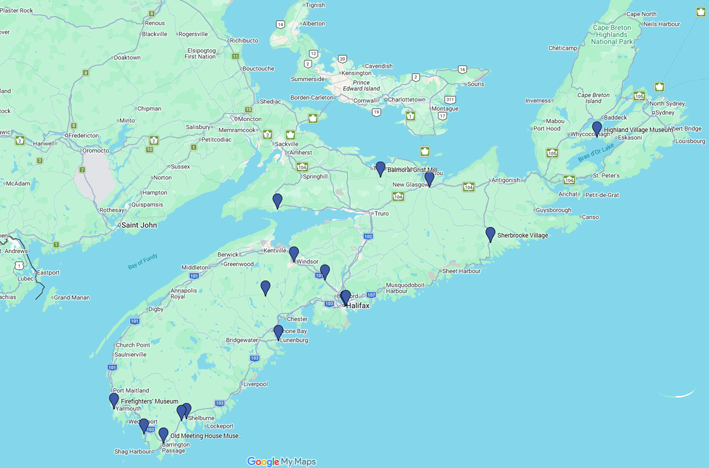
Nova Scotia Museum listed by Nova Scotia Tourism Regions
|
|
Halifax Metro |
|
Fundy Shore & Annapolis Valley |
|
|
South Shore |
|
Northumberland Shore |
|
|
Yarmouth & Acadian Shores |
|
Cape Breton Island |
|
|
Eastern Shore |
Halifax Metro
Museum of Natural History
What does a great horned owl sound like? How many species of whale live in the Gully? How old is Gus the gopher tortoise?
Discover the answers to these questions and more as you explore Nova Scotia’s forest, ocean and more at the Museum of Natural History. Observe live reptiles and amphibians, learn about Earth and space with Science on a Sphere, and discover thousands of years of history with Mi’kmaq artifacts. From the sands of Sable Island to the wings of a honeybee, there’s something for everyone.
Maritime Museum of the Atlantic
Located in the heart of Halifax’s historic waterfront, there’s no better place to immerse yourself in Nova Scotia’s rich maritime heritage than the Maritime Museum of the Atlantic.
From small craft boatbuilding to World War Convoys, the Days of Sail to the Age of Steam, the Titanic to the Halifax Explosion, you’ll discover the stories, events and people that have come to define this province and its relationship with the sea.
Uniacke Estate Museum Park
Turn along the treed roadway at Uniacke Estate Museum Park and feel like you’re traveling a direct route to the 1800s! Arrive at an elegant home overlooking Lake Martha, once known as a prominent place on one of only two “great roads” in Nova Scotia.
Here, Richard John Uniacke, a prosperous Irish politician, built his country mansion in 1816. One of the grandest houses in Nova Scotia, it became a favorite home for seven generations of his large family.
Inside, find a rare survival of one family’s treasured possessions. See fine, labeled London furniture and exquisite portraits at home in this house for hundreds of years. Outside, explore the English country landscape, do some birdwatching and stroll or hike along eight modern walking trails.
South Shore
Ross Farm Museum
Come to Ross Farm Museum to explore 60 acres of rolling farmland and discover what life was like on a Nova Scotia family farm over 100 years ago.
An authentic, living heritage site, much of the farm remains the same as it was in the 1800s. From historic Rose Bank Cottage where the Ross family lived, to daily activities such as wool spinning, candle making, and ox shoeing, the museum gives visitors the chance to experience yesterday’s traditional farming methods, while learning sustainable ways of living for today.
Chat with costumed interpreters, hike the scenic nature trail, take a wagon ride or winter sleigh ride, and meet the animals who live and work on the farm as you connect with Nova Scotia’s rural heritage. Whether you’re milking a cow or enjoying the site’s natural beauty, Ross Farm Museum provides a unique glimpse of life in the 19th-century.
Fisheries Museum of the Atlantic
Come and explore life at sea, up-close and personal at the Fisheries Museum of the Atlantic in the UNESCO World Heritage Town of Lunenburg.
Learn about Rum Running, whales and August Gales. Have a yarn with old salts and enjoy Bluenose memorabilia. Walk the docks, visit our wharf-side vessels and refresh in the salt air as you take in one of the best maritime moments in the world.
Visit the Salt Store Gift Shop or dine at the Old Fish Factory Restaurant. Come rain or shine and discover something for all ages in one of Nova Scotia’s most celebrated fishing communities!
Black Loyalist Heritage Centre
The Black Loyalist Heritage Centre tells the story of the world’s largest free African population outside of Africa, in the late 18th century in Nova Scotia.
Enjoy the view of Birchtown Bay when you climb up the Shaw Turret, which commemorates all Black Loyalist communities in Nova Scotia. Enter the Centre’s Lindsay Gallery and immerse yourself in the multimedia presentation of the Black Loyalist journey from Africa to the American colonies, then to Nova Scotia and back to Africa. Explore the virtual copy of the Carlton’s Book of Negroes and search for an ancestor who may have experienced part of this incredible journey.
The Dory Shop Museum
Step into this authentic harbour-side dory factory to discover the historic Shelburne Dory and enter the world of the famous Grand Banks fishery as it existed from 1880 to 1971.
Learn how Shelburne dorymakers rivaled their Lunenburg competitors by using the dory clip. Find out why the reliable dory was the backbone of the east coast fishery and the most popular small craft in the Atlantic Provinces for almost a century.
Old Meeting House
Among the oldest in North America, this meeting house was a building-in-progress for its first hundred years. Built by Congregationalist fishermen and farmers from Cape Cod, called Planters, the windows, doors, box pews, and a pulpit were added by the mid-1800s. People have gathered in this building for both township business and religious worship for two centuries. Inside, see period “graffiti” and listen to the resounding acoustics as you read a historic sermon. Outside, on gravestones in the cemetery, discover the stories of some early settlers.
Yarmouth & Acadian Shores
The Acadian Village of Nova Scotia / Le Village Historique Acadien de la Nouvelle-Écosse
Stop in, sit down and bask in Acadian heritage at this early 1900s seaside village, situated on a beautiful 17-acre site overlooking Pubnico Harbour.
Founded in 1653 by Sieur Philippe Mius-d’Entremont, this remarkable community showcases the industrious and joyful spirit of the Acadian people, celebrating a language and culture that has thrived for more than 350 years.
Learn the village’s history, hear Acadian spoken, experience fishing and farming traditions, explore historic wooden homes and buildings, savour home-cooked Acadian cuisine and enjoy hospitality that is second to none.
Firefighters' Museum of Nova Scotia
Imagine the clang of the fire bell, the smell of smoke and the feel of hot steam as firefighters of the past raced to save burning homes in Yarmouth and communities across Nova Scotia.
See types of fire engines used in Nova Scotia from the 1800s to the 1930s. Marvel at antique hand-drawn and operated engines such as Canada’s oldest horse-drawn steam engine, an 1863 Amoskeag Steamer. Take the wheel of a 1933 Chev Bickle pumper as you discover the history of firefighting in this province.
Fundy Shore & Annapolis Valley
Clifton Museum Park
Wind your way up the tree-lined drive to visit the beautiful park and grand home. Built in 1835 by Nova Scotian author and judge Thomas Chandler Haliburton and his wife Louisa, The property's sixteen owners and tenants each left their mark inside and out.
The word Clifton evolved from the Old English words clif (cliff or bank) and tun (town, settlement, farmstead), meaning town near the cliff. Situated in the town of Windsor along the banks of the Avon River, Louisa thought it was the perfect place to name after her hometown of Clifton, England.
The Birthplace of Hockey Museum is located in one wing of Clifton Museum. Filled with two hundred years of hockey history and artifacts, see the influences and evolution that led to the game we know today.
Fundy Geological Museum
Come and explore Nova Scotia’s ancient world near the Bay of Fundy, where the world’s highest tides erode the towering sea cliffs to reveal evidence of 350 million-year-old fossils and local minerals, including amethyst and agate gem stones. Discover these Jurassic and Triassic landscapes where Canada’s oldest dinosaurs once roamed and learn about the animals that lived in their shadows. Visit the Fundy Geological Museum to unearth this province’s rich geological past!
Northumberland Shore
Balmoral Grist Mill
Come discover Balmoral Grist Mill Museum; a three-storey mill tucked away in a wooded gorge on Matheson’s Brook.
See the mill in action, just as it would have been when Alexander McKay opened it in 1874. Hear the whir of wooden gears as shafts and pulleys turn the original Scottish granite millstones. Watch as grains are ground, sifted and turned into flour.
Sample the flavour of oats toasted on the cast iron floor of the kiln. Treat yourself to the experience of a waterside grist mill from Nova Scotia’s past.
Museum of Industry
Come explore Atlantic Canada’s largest museum to discover the people, places and machines of Nova Scotia’s industrial past. Push, pull, lift, drop and laugh as you enjoy acres of exhibits and interactive displays that highlight how technology – and people – worked throughout this province’s history.
Do your best to keep pace on the assembly line, test your strength at the weights and pulleys stations, get a workout at the water-powered pumps and bask in the spirit of invention as you marvel at Canada’s oldest surviving steam engine. Featuring 30,000 artifacts, there’s no better place to find out the true meaning of “Made in Nova
Scotia” than the Museum of Industry!
Cape Breton Island
Baile nan Gàidheal | Highland Village
Experience Nova Scotia’s Gaelic culture, heritage and hospitality at this living history museum and folk-life centre in scenic Iona, located in the heart of Cape Breton and overlooking the magnificent Barramens Strait on the Bras d’Or Lakes.
Take part in a traditional céilidh, hear Gaelic singing, learn to speak Gaelic phrases, and become captivated by the spirit of pioneering Scottish Gaels. See costumed animators demonstrate skills such as weaving, quilting and rug hooking. Explore the beautiful rural setting that features a Hebrideanstyle blackhouse, a 19th-century wooden church, period farmhouses, and rare farm animals such as Soay sheep and Highland cattle.
Eastern Shore
In the 1860s, timber, tall ships and gold ruled life along the St. Mary’s River, turning the community of Sherbrooke into a prosperous boom town. Today, the picturesque village still stands proud, just as it did more than 100 years ago.
Get your hands on history as you explore this incredible living site where costumed interpreters bring history to life in 25 original heritage buildings on 53 acres, offering plenty of room to breathe the fresh air. Watch sparks fly as the blacksmith’s hammer hits the anvil, see the weaver’s nimble hands at the loom, smell the newly shaved wood in the wood turner’s shop, and hear the thump of the printer’s manual press. Make our past your adventure by taking part in one of our many daily activities and experiences or by signing up for a multi-day learning camps and events.
Effective 2026, the following museums are permanently closed: Cossit House, Lawrence House, McCulloch House, Perkins House, Prescott House, Ross-Thomson House, Shand House, Barrington Woolen Mill, Sutherland Steam Mill, Wile Carding Mill, Fisherman’s Life Museum and North Hills Museum.
For more information, please click here.