


Photo Caption
Titanic's 1st class staircase closely resembled Olympic's, shown here in the Museum's exhibit. US Library of Congress US Z62-26812
Fighting to exploit increased immigration, business and leisure travel were rival steamship lines: the Cunard Line (originally founded by Samuel Cunard from Halifax) and the White Star Line. When Cunard launched the giant Mauretania in 1907, White Star Line responded with plans for two of the largest steamships in the world, Olympic and Titanic.
Titanic was launched on May 31, 1911. Building on lessons from Olympic, it was an extra thousand tons and carried one hundred more passengers. For its brief career, it was the largest ship in the world. Larger ocean liners were built after Titanic, but few ever matched its legendary reputation for lavish craftsmanship. Titanic's seven decks provided the facilities of a medium-sized city, from post office to cafés. Three passenger classes were segregated by locked barriers, ranging from the lavish decoration and country club facilities in First to the bare painted steel, low ceilings, and naked lightbulbs in Third.
Titanic left Southampton on April 10, 1912, stopping briefly in Cherbourg, France and Queenstown (now Cobh), Ireland. It was due in New York on April 17.
Sinking
Despite numerous ice warnings, Titanic steamed full speed into a massive field of icebergs. The vessel struck one at 11:50 pm, April 14 and sank two hours and forty minutes later. Its reported position, 41 46 Lat. 50 14 Long., was 700 nautical miles east of Halifax. There were over 2200 people aboard Titanic. Only 705 survived. In the first few hours of confusion, officials in New York believed that a damaged Titanic would come to Halifax, the closest major port. Special trains were on the way with relatives and immigration officials, when the news broke that Titanic was gone forever. The Cunard liner Carpathia was taking survivors to New York. The dead would come to Halifax.

Recovery
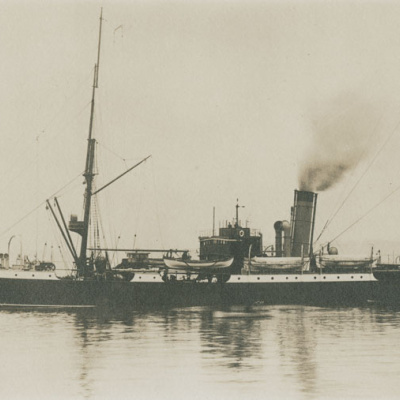
The strategic position of Halifax made it the base for cable ships which repaired breaks in the underwater telegraph cables connecting Europe and North America. The White Star Line turned to these ships to search for bodies. Their tough crews, used to working in rough seas and ice, were ideally suited for the grim task.
Before survivors arrived in New York, the first cable ship left Halifax to search for bodies. With coffins, one hundred tons of ice, an undertaker, and a chaplain, Mackay-Bennett left on April 17, arriving on-site three days later. The crew found 306 bodies. Embalming fluid quickly ran out, so 116 were buried at sea. Another cable ship, Minia, departed Halifax on April 22, relieving Mackay-Bennett and finding another 17 bodies. The Canadian Government lighthouse supply ship Montmagny left Halifax on May 6 and found four additional bodies. The Newfoundland sealing vessel, Algerine, sailed on May 16 but found the body of steward James McGrady, the last to be recovered. In total, 328 bodies were found. Twelve hundred were never recovered. Some sunk with Titanic, while others were dispersed by currents, severe weather, and ice.
For the 209 Titanic bodies that came to Halifax, the Deputy Registrar of Deaths, John Henry Barnstead, improvised a remarkable identification system. Bodies were numbered as they were pulled from the sea and personal effects were bagged with the same number. Further details, such as tattoos, clothing, and jewellery, were noted.
-
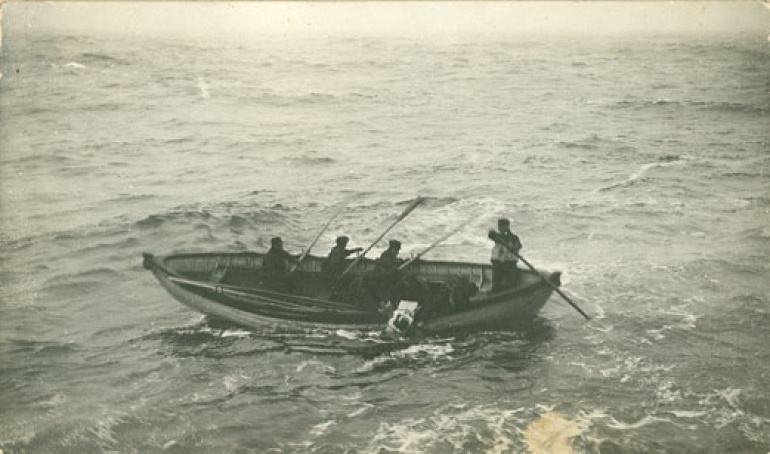
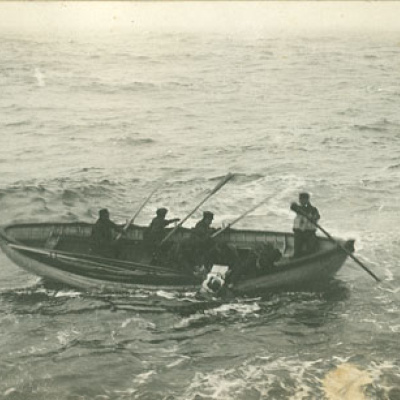
A boat crew from the Cable Ship Minia picks up one of the Titanic victims. Recovery was hard, grim work, amidst large waves and dangerous ice floes. Crews were paid double and given extra rum rations. MMA, M2009.74.1 MMA, M2009.74.1 -
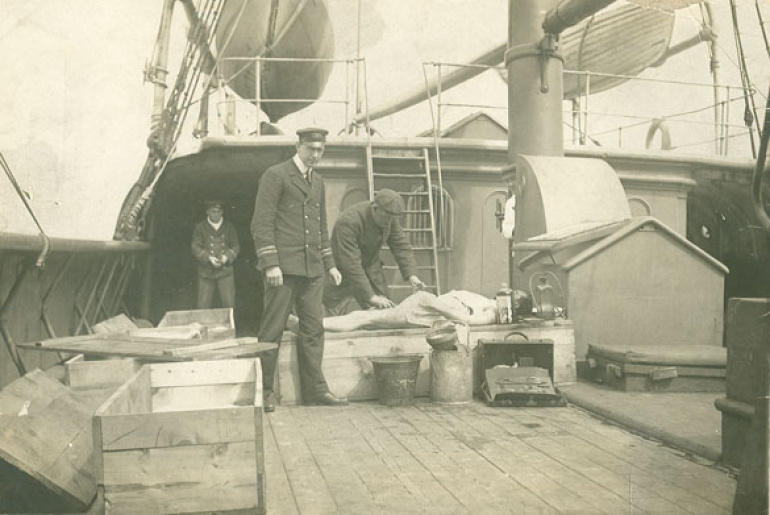
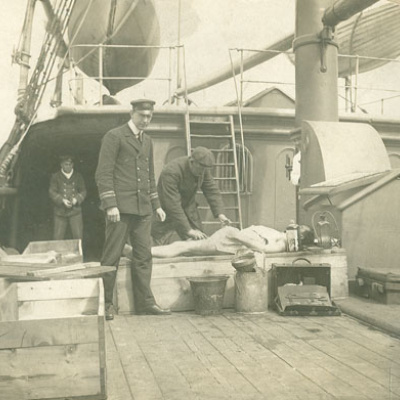
A Titanic victim is embalmed aboard the cable ship Minia. Nova Scotia Archives and Records Management, N-715 -
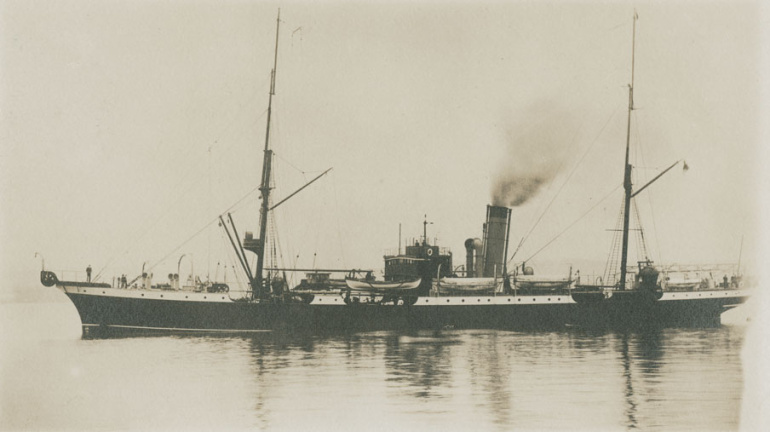
: With flags at half mast and coffins stacked on the stern, Mackay-Bennett arrived in Halifax to the tolling of church bells on 30 April 1912. M.M.A., MP 29.3.1


Identification
Fifty-nine bodies were shipped home to relatives, but one hundred and fifty were buried in three Halifax cemeteries: 121 graves at Fairview Lawn (nondenominational), 19 graves at Mount Olivet (Catholic) and ten graves at Baron de Hirsch (Jewish). The victims range from the Presidential Secretary of the White Star Line to orchestra members and coal stokers. About one third are unidentified.

Photo Caption
Titanic victims are landed from Minia at the Naval Dockyard in Halifax.
Photo Credit
MMA, M2009.74.2
Lessons Learned
Lifeboat Reform
Most people aboard Titanic were doomed because there were not enough lifeboats for everyone. After Titanic sank, additional lifeboats were immediately installed on North Atlantic steamships. Within a year, international regulations required lifeboats for everyone. Regular drills were also implemented to ensure timely launches.
The Role of Wireless
Investigations revealed that heavy commercial wireless traffic had taken priority over ice warnings. Some exhausted wireless operators were off duty and asleep when Titanic called. New regulations required a continuous watch for distress calls. They also called for automatic alarms, which would trigger during a distress calls.
International Ice Patrol
Before Titanic, vessels depended on seasonal ice predictions and occasional reports from other ships. These reports were often ignored. After Titanic, an international ice patrol was established to track ice movements, issue warnings, and research ice conditions.
Barnstead’s Method
Barnstead's system proved invaluable after a much larger disaster in 1917 when it was used again to handle and identify the 2000 victims of the Halifax Explosion. In 1992, Barnstead's meticulous records allowed researchers to put names on six previously unidentified Titanic graves.
Discovery
Lying 3.8 kilometres underwater, Titanic's wreck remained undisturbed until 1985 when it was discovered by a French and American expedition. Important scientific studies of Titanic's wreck have been led by Canadian scientists at the Bedford Institute of Oceanography in Halifax. They include the first tests of Titanic's steel plating and pioneering studies of the iron drippings called "rusticles," that cover the wreck.
Titanic's wreck has also attracted salvagers who have picked over the wreck for commercial display. Most marine museums oppose salvaging. They consider Titanic to be a grave site, requiring minimal intervention.

Titanic deckchair, recovered by Minia and given to Rev. Henry W. Cunningham for his work performing memorial services and burials at sea.
M81.228.1

Titanic and Popular Culture
Titanic instantly became famous in popular culture. Within weeks of its loss, films, books, and countless musical pieces were produced. Interest has ebbed and flowed over the decades as each generation finds new meanings in the Titanic tragedy.
References
Brown, Richard. Voyage of the Iceberg, (1983). The sinking from the iceberg's point of view, written by a Canadian scientist exploring the natural and human history of the disaster.
Eaton, John and Charles Haas. Titanic: Triumph and Tragedy (2nd Edition, 1997). An exhaustive account, including a detailed chapter on the role of Halifax.
Lord, Walter. A Night to Remember (1955) The classic minute by minute account of the disaster.
Lynch, Don and Ken Marschall. Titanic: An Illustrated History (1992 ) A beautifully illustrated and detailed portrait of Titanic.
Ruffman, Alan, Titanic the Unsinkable Ship and Halifax (1999) The most authoritative account of Halifax's role, beautifully illustrated by the Maritime Museum of the Atlantic's collection.